







How a Lens’s Character is Shaped

By Camera & Light Editorial Team
This October, the AEC and Canon organised an event devoted to understanding how the design of a lens determines its visual response. At this exclusive workshop, Carlos Castán explored concepts such as aberrations, light transmission and contrast, and how these variables can be used to create different visual characters. The session connected technical fundamentals with the choices made by cinematographers and concluded with comparative tests in the lens projection room at Canon’s Madrid headquarters.
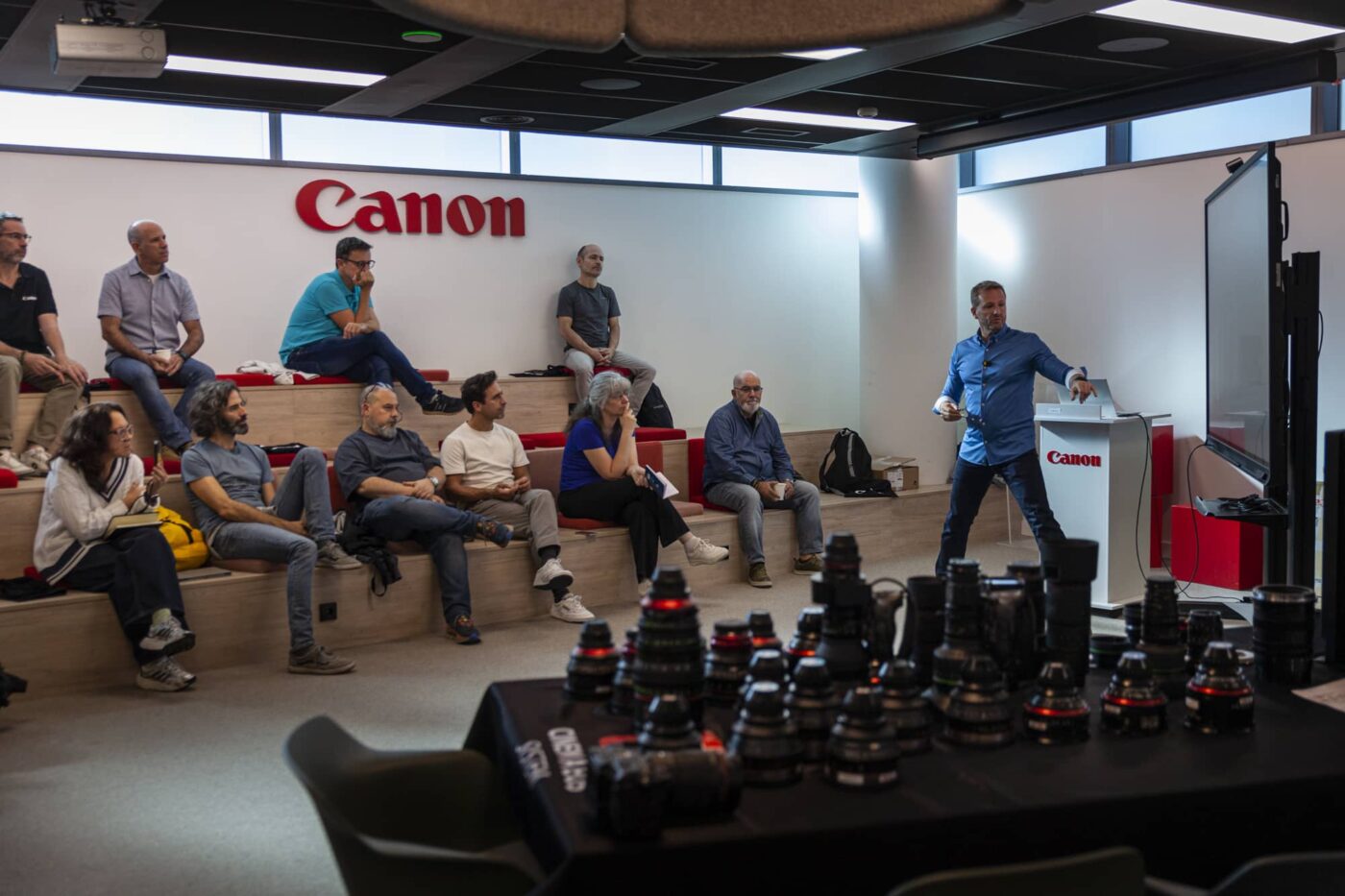
“Lenses are your tool for controlling light,” Carlos Castán reminded participants at the event organised by the Asociación Española de Directoras y Directores de Fotografía (AEC) and Canon. With fifteen years’ experience in broadcast lens servicing and support, Carlos examined the design decisions that explain why two lenses can produce such different images. The session covered photographic and cinema lenses, broadcast models and hybrid Cine-Servo solutions, which combine coverage for large sensors with motorised operation. Each lens family responds to production requirements that shape its design and performance.
Aberrations as a tool
The starting point was image formation. The curvature of the elements and the refractive index of their materials determine how light is refracted as it passes through them. Because this index varies with wavelength, different colours do not behave in exactly the same way within the optical system.
Castán reviewed the five classical geometric aberrations. Spherical aberration causes rays from the same on-axis point to come to focus at different distances depending on whether they pass through the central or peripheral areas of the lens; coma distorts the reproduction of off-axis points; and astigmatism produces different focal positions for two perpendicular orientations. Field curvature means that a flat object is brought into best focus on a curved surface, while distortion alters the geometry of the image.
Chromatic aberrations introduce another variable. With longitudinal chromatic aberration, colours come into focus at different positions along the optical axis; with lateral chromatic aberration, they are reproduced at different magnifications. Both may produce coloured fringes: they share an origin in chromatic dispersion, but differ in how they manifest themselves.
Correcting these phenomena requires combinations of materials and optical designs. Aspherical elements make it possible to compensate for spherical aberration, while fluorite and low-dispersion glass help reduce chromatic aberration. The design of the optical groups must reconcile these corrections with focal length, lens speed and the overall size of the assembly.
In cinematography, this process also allows designers to decide which characteristics to preserve or accentuate. The control of spherical aberration affects contrast transitions and the appearance of bokeh. A design can introduce a soft halo around detail and alter the texture of the image. Carlos Castán compared this approach with the use of diffusion filters, using examples to show differences in the transitions between white and black. The key is to “control aberrations to our advantage”.
“The control of spherical aberration affects contrast transitions and the appearance of bokeh.”
The light reaching the sensor
Lens speed opened another part of the discussion. The f-number expresses the relationship between focal length and entrance pupil diameter, but does not account for light lost as it passes through the lens. Two lenses with the same f-number can transmit different amounts of light. The T-stop takes that effective transmission into account and provides a more accurate reference for maintaining exposure when changing lenses.
Castán also explained f-drop, the reduction in the maximum available aperture on some zoom lenses towards the telephoto end. Keeping the f-number constant requires the entrance pupil diameter to increase in proportion to focal length. When the design limits that increase, the lowest available f-number rises. The image becomes darker if the selected aperture is wider than the lens can maintain during the zoom. Accepting this limitation allows compromises in size and versatility, especially in broadcast; in cinema, it can affect exposure during a zoom move.

Multilayer coatings play an important role in both transmission and contrast. Castán drew on the noise cancellation used in headphones to explain the principle of “destructive interference”: coatings are designed to reduce the light reflected from glass surfaces. Their composition and thickness determine how reflection and transmission vary with wavelength, and affect colour balance.
Internal reflections can produce veiling glare that lifts the blacks and reduces contrast. Baffles and matte finishes inside the lens barrel also help to contain it. This “optical noise”, as Castán called it, reduces the contrast of the image reaching the sensor.
Illumination is not always distributed uniformly across the sensor. Vignetting caused by the obstruction of light rays and the natural fall-off in illumination towards the corners explain differences that should be assessed alongside overall transmission.
What we mean by sharpness
The modulation transfer function (MTF) provided a way to explain the relationship between the reproduction of detail and contrast. As the lines on a test chart become closer together, the optical system finds it harder to maintain the separation between whites and blacks. Assessing how much contrast it retains at different levels of detail and in different parts of the image provides a more precise description of its performance.
The visual comparison shown between the EF and RF 50 mm f/1.2 lenses illustrated differences in reproduction both on test charts and on a real face.
Sensor size introduces other demands. Concentrating the same number of pixels into a smaller area means that a lens must resolve more line pairs per millimetre to make full use of that resolution. Conversely, covering a larger sensor requires a larger image circle. Achieving that coverage with a fast maximum aperture and a wide zoom range has consequences for the size and weight of the assembly.
Mechanical design completes those choices. A long focus-ring throw enables precise adjustments, while the iris design affects the shape of out-of-focus highlights. Gearing and the addition of a servo determine how the lens integrates with accessories and how it is operated. Choosing a lens therefore depends on both its visual response and the practical requirements of the shoot.
Interpreting the tests
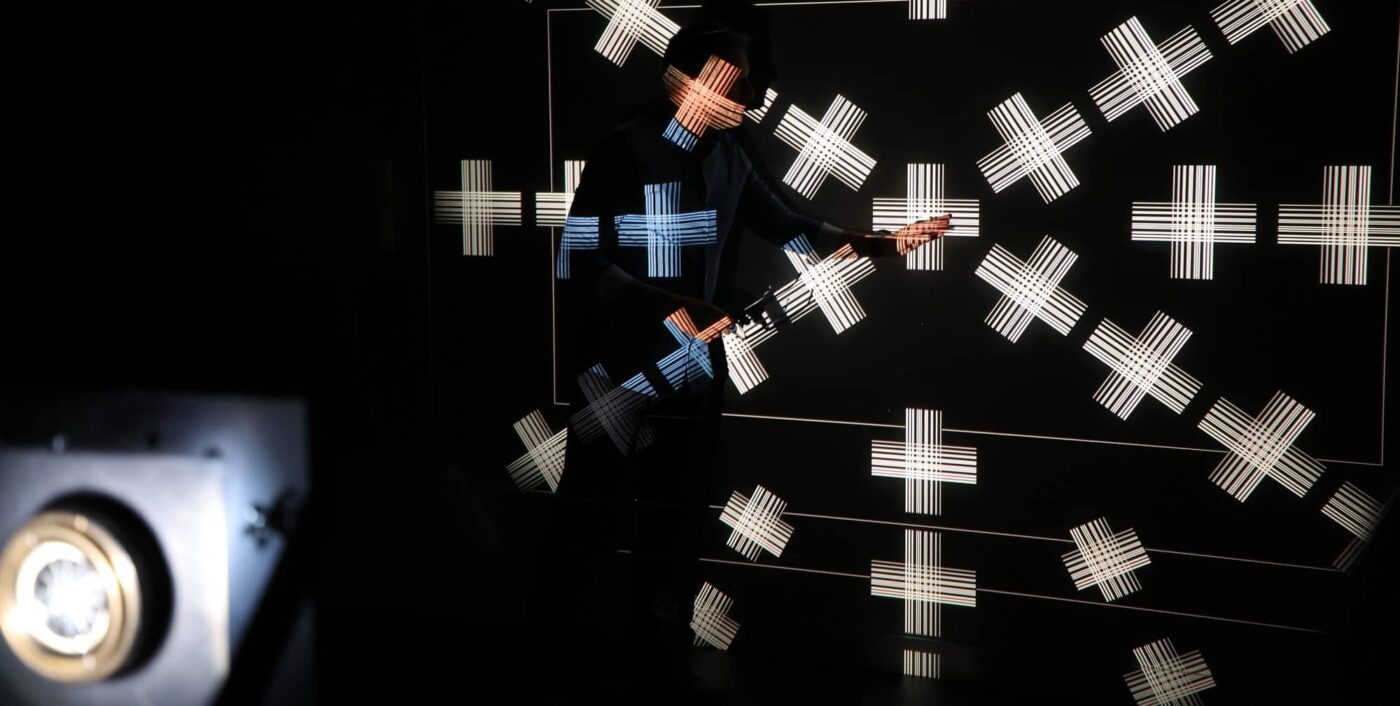
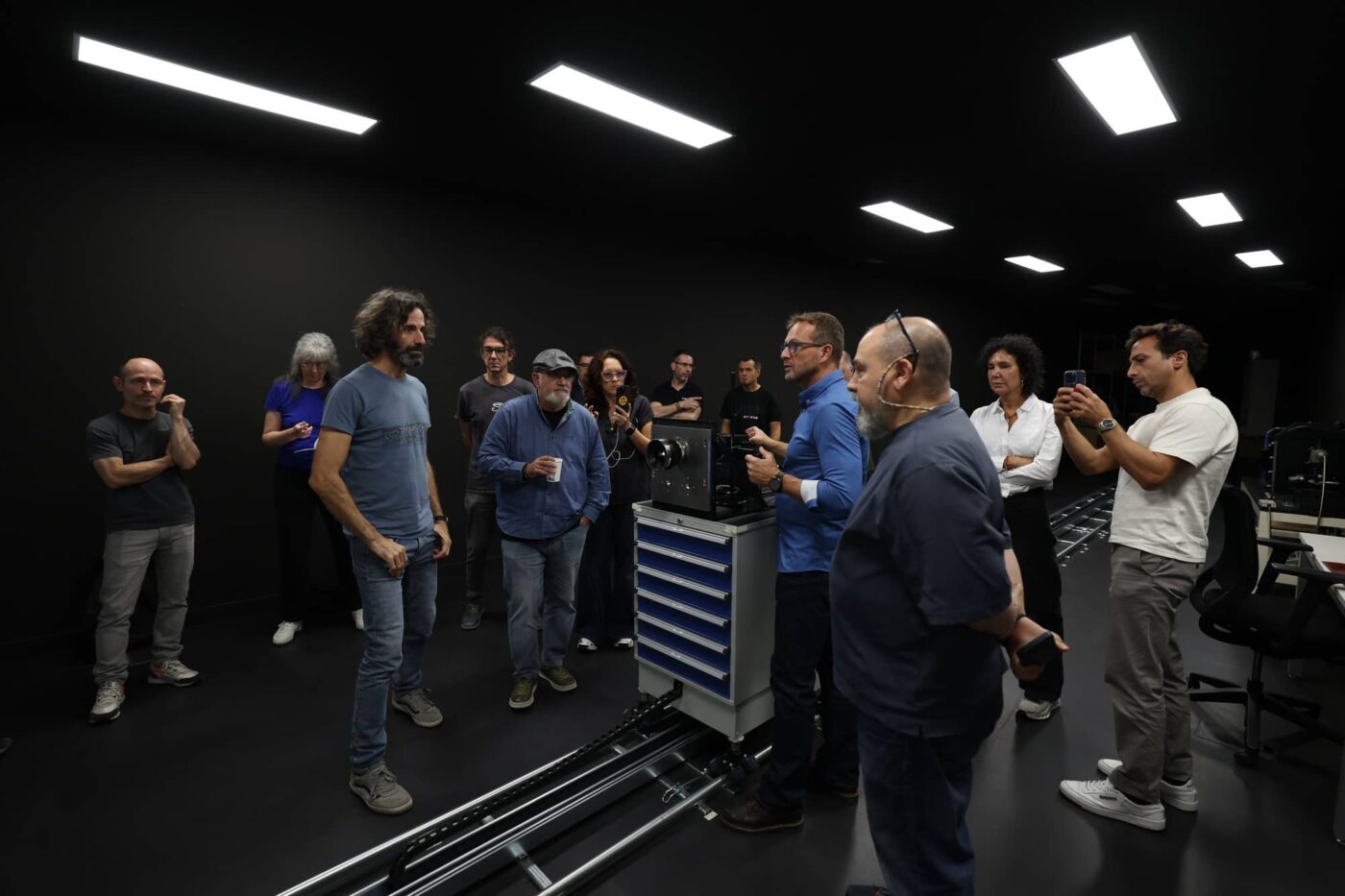
The second part of the session brought these concepts into the technical service room. Projecting test charts made it possible to compare models such as Sumire, V35 lenses based on modified CN-E designs, rehoused FD lenses and various zooms. Chromatic haloes and differences in contrast were visible around the white lines against the black background.
As focus was adjusted, those present could see that, with one of the lenses, the corners came into focus while the centre remained out of focus: an example of field curvature. The session also explained how to investigate a possible tilt or misalignment of the plane of focus when the left and right sides reach their best focus at different positions. Understanding these responses helps distinguish an optical characteristic from a fault requiring technical intervention.
The discussion with AEC cinematographers also underlined the need to complement this evaluation with real-world tests. A chart helps identify specific phenomena, but an aesthetic choice requires observing how they affect the subject being photographed. As Carlos said when discussing colour reproduction: “You have to see it on skin, on faces; with real images.”